

With the rise in interest rates, bond yields have been on the rise; this will dent banks' treasury profits. Also, many retail borrowers may find it difficult to service their loans when the loan rates rise, points out Tamal Bandyopadhyay.

Many individual states experienced higher inflation than the all-India figures during the financial year 2023-24 (FY24). Retail inflation figures in Telangana, Haryana, Rajasthan and Dadra and Nagar Haveli have been higher than national numbers every month of this financial year, shows a Business Standard analysis of state-wise figures, after the March inflation data was released on Friday. Experts noted that persistent high food inflation along with differences in the weights of rural and urban indices plays into the regional variation in inflation rates.
Expect rate rise pause, amid market expectations to the contrary.

Shares of rate-sensitive realty, bank and auto sectors were on buyer's radar on Wednesday.

The Reserve Bank is likely to maintain status-quo on the key interest rates for the third time in a row in its upcoming bi-monthly policy review despite the US Federal Reserve and the European Central Bank hiking benchmark rates, as domestic inflation is within the RBI's comfort zone, say experts. The borrowing cost which started rising in May last year has stabilised with RBI keeping the repo rate unchanged at 6.5 per cent since February when it was raised from 6.25 per cent. In the previous two bi-monthly policy reviews in April and June the benchmark rate was retained.
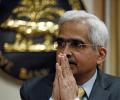
Reserve Bank Governor Shaktikanta Das on Friday said the rupee is holding up relatively well when compared to the currencies of emerging market peers and advanced economies. Days after the domestic currency breached the 80-level against the dollar, Das said Reserve Bank of India (RBI) has zero tolerance for volatile and bumpy movement in the rupee and added that the central bank actions have helped in smoother movement. He said RBI has been supplying US dollars to the market to ensure adequate supply of liquidity and also clarified that the central bank does not target a particular level for the currency.

The S&P BSE Sensex dropped 1 points to end at 26,396 and the Nifty50 slipped 2 points to end at 8,109.
India's GDP for the three-month period ended September 30 grew 7.4%.

Though most experts remain bullish on the banking space, they suggest investors buy only those banks whose NPAs are at a manageable level of 3% to 4% and there is credit growth or earnings visibility.

Reserve Bank Governor Raghuram Rajan is widely expected to hold the key rates citing high inflation at the fourth bi-monthly monetary policy announcement on Tuesday, even though the pro-growth lobby has been wishing for a rate cut.

CEA offers three compelling arguments in his case for privatisation of government-owned banks.

Bharti Airtel , RCom and Tata Communications ended down between 0.1-1%.

The Reserve Bank's rate-setting panel will start its 3-day deliberations on Wednesday amid expectations of yet another rate hike of 50 basis points to check high inflation, in line with similar actions taken by other major central banks, including the US Fed. Based on the recommendations of the Monetary Policy Committee (MPC), the RBI had effected 50 basis points increase in repo rate each in June and August after raising the short-term lending rate by 40 basis points in an off-cycle decision in May. The MPC, headed by RBI Governor Shaktikanta Das, is scheduled to meet during September 28-30.
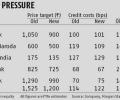
Banking stocks, including top ones like State Bank of India, ICICI Bank, HDFC Bank, Bank of Baroda and Bank of India, among others, have fallen sharply in the last one month.

A section of analysts feel now may not be a bad time to buy select PSBs.

Markets crashed due to domestic worries; bluechip stocks tanked too.

The CBI has shared its findings with the Enforcement Directorate.

Among the private banking majors ICICI Bank and HDFC Bank were down 0.2%-0.5% each.

The S&P BSE Sensex plunged 301 points to close at 25,490 and the Nifty50 fell 86 points to end at 7,815.

The rally followed the govt's plan to bolster state-owned lenders.
Brokers said a flurry of buying by investors in blue-chips mainly influenced the sentiment.

Only three of India's 45 commercial banks have cut base lending rates since the Reserve Bank of India's surprise easing this month, hurting the government's drive to lift business investment.

The 30-share Sensex closed up 34 points at 27,831 and the 50-share Nifty ended up 15 points at 8,356.

India's unabated tryst with Russian crude oil is slowly coming to an end. The time has come for Indian refiners to navigate, creatively, the choppy waters of the post-honeymoon period, and for Indian policymakers to take cognisance of the broader impact on India from the spillover of the Russian crisis - after Washington's warning to transgressors last week. Shipments from Russia to India have averaged over 1.8 million barrels a day since February, according to data from Paris-based market analytics firm Kpler. But much of the crude shipped to India was non-sanctioned because it traded below a price cap set by the US led G-7 nations in December.
Sensex gained 38.18 points or 0.15% at 25,918.95 and Nifty ended higher by 12.50 points or 0.16% at 7,739.55.

The Sensex closed higher by 170 points at 26,128 and the Nifty rose 59 points to end at 7,943.

Sensex eneded 374 points higher on rate cut expectation from the RBI.

The amount you can raise via a gold loan is higher than you can get via a personal loan.

India's equity markets are on a roller-coaster ride, after delivering spectacular returns for two consecutive years - in 2020 and 2021. The benchmark National Stock Exchange's (NSE's) Nifty50 is down 1.5 per cent in the first nine months of the current calendar year 2022 (CY22) as foreign portfolio investors sold Indian stocks due to rising bond yields in the US and across global markets, including India. The sell-off in the Indian equity markets has, however, not been broad-based and largely limited to sectors facing earnings headwinds from rising interest rates, lower commodity and energy prices, and likely economic recession in advanced economies.

It is nearly after 13 years that a foreign brokerage has resumed holistic coverage on stocks of public sector banks (PSBs). To that extent, Morgan Stanley's report dated March 3, where the analysts have listed their order of preference for PSB stocks, is an indication that the state-owned banks may once again be attracting some interest, thanks to three back-to-back quarters of good results in FY21 so far. "State-owned banks' balance sheets have improved, and bad loans formation should moderate going forward," the analysts note and this is the key reason for them to relook at their stance on PSBs. While State Bank of India (SBI) remains their preferred pick, stocks of Bank of Baroda (BOB) and Punjab National Bank (PNB) have been upgraded from 'underweight' to 'equal-weight'. The brokerage maintains its underweight recommendation on Bank of India and Canara Bank.

The S&P BSE Midcap and the S&P BSE Smallcap indices under-performed to lose 0.8% and 1.6%
RBI Governor Raghuram Rajan asked banks to follow suit and pass on the rate cuts.

I kept insisting that Rs 100 notes were in short supply and there was an urgent need to augment the supply of 100 rupee notes while also rapidly bringing into circulation the proposed new Rs 500 notes. But this was easier said than done because all the note printing machines of the RBI were programmed for printing Rs 2,000 notes and required at least three weeks before the machines could print the new Rs 500 currency notes. The availability of currency paper posed another major bottleneck, and it had to be imported. It was decided to immediately start printing the Rs 500 notes. It was only when the supply of the new Rs 500 notes started improving and the process of change of cassettes at the ATMs gathered momentum that the situation began limping back to normal. A fascinating excerpt from former SBI chairman Rajnish Kumar's The Custodian of Trust: A Banker's Memoir, five years after demonetisation, November 8.
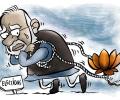
AIBOC in a letter to the Prime Minister, has said the government should not expect the banking fraternity to "join the political campaign of #MainBhiChowkidar" unless issues related to merger of banks, salary revision and staff recruitment, among others, are addressed.

Metal stocks also had a good session, with JSW Steel zooming by 7%, and Tata Steel and Nalco gaining about 3% each.

Financial shares were the top losers.

The 2019 list shows a 37 per cent jump in brand value for the Tata group, to $19.55 billion for 2019, the highest in the top 25.

The S&P BSE Sensex closed 318 points at 24,455 and the Nifty50 shed 99 points to end at 7,438.

The S&P BSE Midcap and the S&P BSE Smallcap indices added 0.5% and 0.7%, respectively
